From War to Engineering: How FEM Developed
𝐅𝐫𝐨𝐦 𝐖𝐚𝐫 𝐭𝐨 𝐄𝐧𝐠𝐢𝐧𝐞𝐞𝐫𝐢𝐧𝐠: 𝐇𝐨𝐰 𝐅𝐄𝐌 𝐖𝐚𝐬 𝐁𝐨𝐫𝐧
The world is entering unstable times again. And once more, we are seeing some of the most advanced technologies come to light.
It is a bit ironic — 𝒎𝒂𝒏𝒚 𝒐𝒇 𝒕𝒉𝒆𝒔𝒆 𝒕𝒆𝒄𝒉𝒏𝒐𝒍𝒐𝒈𝒊𝒆𝒔 𝒘𝒆𝒓𝒆 𝒏𝒐𝒕 𝒐𝒓𝒊𝒈𝒊𝒏𝒂𝒍𝒍𝒚 𝒅𝒆𝒗𝒆𝒍𝒐𝒑𝒆𝒅 𝒇𝒐𝒓 𝒅𝒂𝒊𝒍𝒚 𝒍𝒊𝒇𝒆, 𝒃𝒖𝒕 𝒇𝒐𝒓 𝒘𝒂𝒓.
A simple example is GPS. Civilian accuracy is a few meters, while military systems can reach centimeters. This gap shows that the most advanced technologies are often kept as national secrets before becoming public.
In our civil engineering field, there is something many people may not realize: 𝐭𝐡𝐞 𝐅𝐢𝐧𝐢𝐭𝐞 𝐄𝐥𝐞𝐦𝐞𝐧𝐭 𝐌𝐞𝐭𝐡𝐨𝐝 (𝐅𝐄𝐌), one of the most important tools we use today, also has roots in military needs.
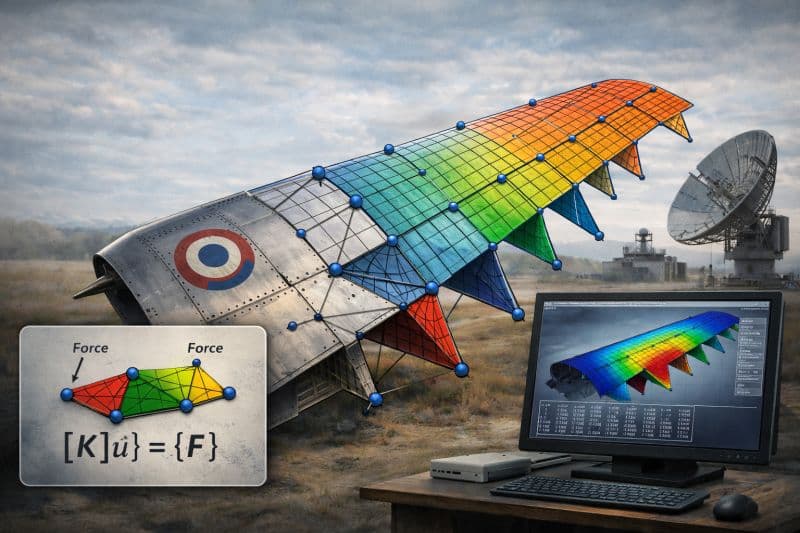
During World War II, the aerospace industry developed very quickly. Engineers had to design aircraft wings that were both light and strong, able to handle complex loads, vibration, and aerodynamic forces.
So engineers came up with a new idea:
Instead of trying to solve the whole structure at once, they divided it into many small, simpler pieces, solved each part, and then connected everything together.
That idea became the foundation of FEM. It started from practical needs during wartime and was developed into a complete method in the following decades.
𝐅𝐢𝐧𝐢𝐭𝐞 𝐄𝐥𝐞𝐦𝐞𝐧𝐭 𝐌𝐞𝐭𝐡𝐨𝐝 (𝐅𝐄𝐌)
Imagine a large structure, we do something very simple: We break it into many small pieces.
◉ Each small piece has its own behavior. It reacts to forces depending on: material, shape and size
◉ And these pieces are not independent. They are connected at points called nodes. And at these nodes, there is an important rule: All connected pieces must move together. They cannot separate or behave differently.
Also, at boundaries (like supports), movement can be fixed or limited.
Because of all these connections and constraints, the structure cannot deform freely. Everything must satisfy all conditions at the same time.
To make that happen, we build and solve a very large system of equations.
🔷 It is a 𝐒𝐲𝐬𝐭𝐞𝐦 𝐨𝐟 𝐋𝐢𝐧𝐞𝐚𝐫 𝐄𝐪𝐮𝐚𝐭𝐢𝐨𝐧𝐬
This is the only way to ensure that all parts “agree” with each other.
Once we solve it, we get the displacement, then we can calculate stress, strain, and internal forces.
It can be used for almost anything — 1D, 2D, 3D problems. It can handle complex shapes and combine different physical effects like mechanics, heat, and fluid flow.
And most importantly, computers can handle the huge system of equations behind it.
► 𝐓𝐡𝐚𝐭’𝐬 𝐰𝐡𝐲 𝐢𝐭 𝐢𝐬 𝐨𝐟𝐭𝐞𝐧 𝐜𝐨𝐧𝐬𝐢𝐝𝐞𝐫𝐞𝐝 𝐭𝐡𝐞 “𝐡𝐨𝐥𝐲 𝐠𝐫𝐚𝐢𝐥” 𝐨𝐫 “𝐦𝐚𝐠𝐢𝐜 𝐭𝐨𝐨𝐥” 𝐨𝐟 𝐜𝐨𝐦𝐩𝐮𝐭𝐚𝐭𝐢𝐨𝐧𝐚𝐥 𝐦𝐞𝐜𝐡𝐚𝐧𝐢𝐜𝐬.
Just a random thought about engineering and FEM while watching the world change again.