Why Diagonal Bracing Matters in Bamboo Scaffolding
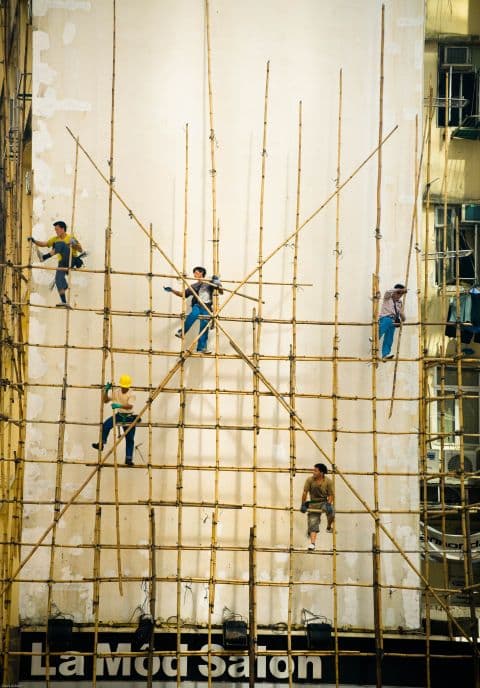
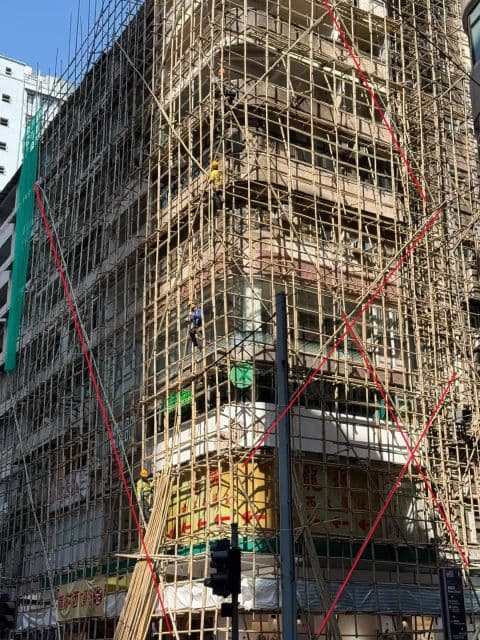
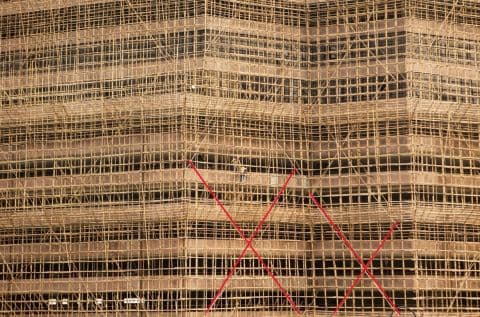
When we look at the bamboo scaffolding around tall buildings in Hong Kong, we can notice something interesting. Unlike modern steel scaffolding, which usually has diagonal braces in almost every small frame, bamboo scaffolding often does not use diagonal braces in each small bay. Instead, it uses large diagonal braces that run across big areas of the whole system.
As a structural engineer, the question is: Why do these diagonal braces exist?
1. From school, we learned a special fact about triangles. A triangle is the stiffest and most stable shape in 2D geometry. If we know all three side lengths, the shape of the triangle is completely fixed. Even if we rotate, flip, or move it, the triangle keeps the same shape.
2. Later, when we learn about materials, we understand that most materials are much stronger in tension and compression than in bending. To increase bending strength, we need to place material far from the neutral axis. A triangle naturally does this. If we try to bend one side of a triangle, we must stretch or compress the other two sides. This makes the triangle very stiff and hard to deform.
3. In structural engineering, we learn the formula for a perfect truss:
m = 2j − 3, where m - the number of members and j - the number of joints.
Only a triangle satisfies this condition of stability: 3 = 2×3 − 3. This means the triangle is the basic stable unit of all truss systems.
4. In structural mechanics, we also learn about Degrees of Freedom (DOF). Every node in 2D has 2 DOF (movement in x and y).
A triangle has 3 nodes → 6 DOF total. A triangle has 3 rigid sides → 3 distance constraints. So the remaining DOF is 6 − 3 = 3. These 3 DOF are: translation in X and Y, and rotation of the whole shape. These are rigid-body movements, so the triangle cannot deform inside the plane.
For a square: 4 nodes → 8 DOF, and only 4 constraints. The remaining DOF is 8 − 4 = 4. After removing 3 rigid-body DOF, the square still has 1 extra DOF, which is shear deformation. This is why a square can easily change into a parallelogram.
So, the triangle is the only 2D polygon that cannot change shape. This simple fact is the foundation of all structural systems today. Every safe structure depends on triangles.
Scaffolding needs diagonal braces to create triangles.
Truss bridges are built from many triangles.
Tower cranes are made from triangular modules.
Building frames and many everyday structures need cross-bracing to form triangles and prevent sway.
In Hong Kong, bamboo scaffolding also follows this rule. The large diagonal braces, usually at 45–60 degrees, connect the vertical poles with the horizontal members. These braces divide the frames they pass through into many small triangles, and also create big triangles at the global scale. Because of these large diagonal braces, the whole scaffolding system becomes much more stable and gains strong resistance against deformation and sway.