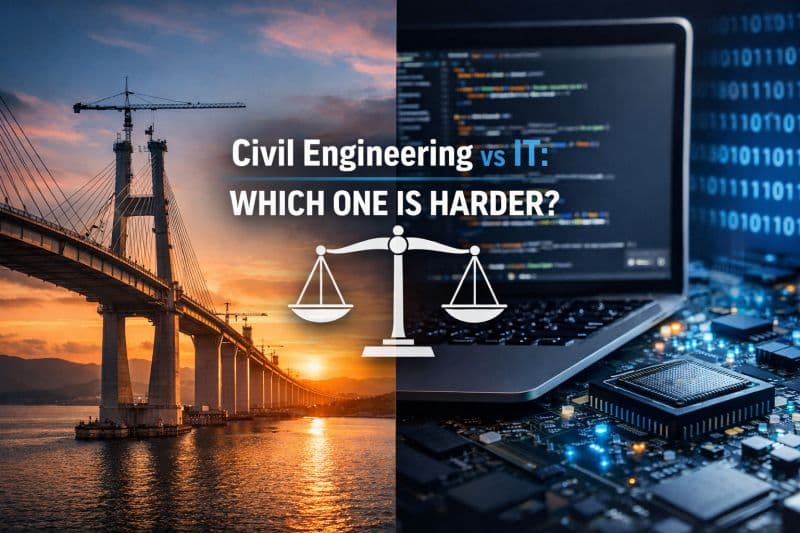
Civil Engineering vs IT: Which One Is Harder?
𝐂𝐢𝐯𝐢𝐥 𝐄𝐧𝐠𝐢𝐧𝐞𝐞𝐫𝐢𝐧𝐠 𝐯𝐬 𝐈𝐓: 𝐖𝐡𝐢𝐜𝐡 𝐎𝐧𝐞 𝐈𝐬 𝐇𝐚𝐫𝐝𝐞𝐫
Recently, I spoke with some friends working in AI, and they asked an interesting question: Is civil engineering hard, and how should we think about career paths for our kids given recent AI layoffs?
It made me reflect, and I’d like to share a few simple thoughts.
● 𝐄𝐱𝐩𝐞𝐫𝐢𝐞𝐧𝐜𝐞
Civil engineering is experience-driven. Most knowledge is built on previous generations, so key roles usually come after many years of practice, often in the 50s or 60s.
In contrast, IT allows faster growth. Talented individuals can stand out early, even during university.
● 𝐖𝐚𝐲 𝐨𝐟 𝐭𝐡𝐢𝐧𝐤𝐢𝐧𝐠
Being good at math and logic is important, especially in IT. However, for engineering, that is not enough.
A good engineer is usually someone who observes the real world. When they see a structure, they naturally ask questions like: “Why is it designed this way?” or “Why not another solution?” This habit of observing and questioning is what really builds strong engineering thinking.
● 𝐂𝐚𝐫𝐞𝐞𝐫 𝐬𝐜𝐨𝐩𝐞 𝐚𝐧𝐝 𝐢𝐧𝐜𝐨𝐦𝐞
From a practical point of view, IT has a much larger scale. A software product can reach millions or billions of users, grow quickly, and create very high income potential without a clear limit.
In contrast, civil engineering projects, like bridges, have high value but serve a specific region, so the financial ceiling is more limited.
● 𝐃𝐢𝐟𝐟𝐢𝐜𝐮𝐥𝐭𝐲
If you are a person who loves very hard challenges, civil engineering may not always satisfy you in the same way as some other fields.
I once told my wife, who is a biotechnology researcher, something like this: I can explain to you many of the things you see in front of your eyes — things that are extremely large, like very tall buildings or bridges reaching into the sky — things so big that humans look tiny compared to them.
And she replied with a very simple but very sharp point:
𝑻𝒉𝒆 𝒕𝒉𝒊𝒏𝒈𝒔 𝒚𝒐𝒖 𝒄𝒂𝒏 𝒔𝒆𝒆 𝒂𝒏𝒅 𝒆𝒙𝒑𝒍𝒂𝒊𝒏 𝒂𝒓𝒆 𝒐𝒇𝒕𝒆𝒏 𝒔𝒊𝒎𝒑𝒍𝒆𝒓 𝒕𝒉𝒂𝒏 𝒕𝒉𝒆 𝒕𝒉𝒊𝒏𝒈𝒔 𝒚𝒐𝒖 𝒄𝒂𝒏𝒏𝒐𝒕 𝒔𝒆𝒆 𝒃𝒖𝒕 𝒔𝒕𝒊𝒍𝒍 𝒉𝒂𝒗𝒆 𝒕𝒐 𝒊𝒎𝒂𝒈𝒊𝒏𝒆 𝒂𝒏𝒅 𝒆𝒙𝒑𝒍𝒂𝒊𝒏. ☺
When I thought about it again, I realized she was right.
☛ Many of the hardest problems today are not the big things we can see, but the very small ones—like semiconductors, precision materials, or cell structures.
✔ In general, technology will continue to improve productivity across all industries, so IT will always remain a core field. At the same time, as long as humans exist, civil engineering will always be essential, as we will always need infrastructure to live, move, and build our world.
However, in the future, IT alone may not be enough, it becomes much more valuable when combined with another expertise.
✔ 𝑰 𝒃𝒆𝒍𝒊𝒆𝒗𝒆 𝒕𝒉𝒐𝒔𝒆 𝒘𝒉𝒐 𝒄𝒐𝒎𝒃𝒊𝒏𝒆 𝑰𝑻 𝒘𝒊𝒕𝒉 𝒂 𝒄𝒐𝒓𝒆 𝒅𝒊𝒔𝒄𝒊𝒑𝒍𝒊𝒏𝒆 𝒘𝒊𝒍𝒍 𝒉𝒂𝒗𝒆 𝒂 𝒔𝒕𝒓𝒐𝒏𝒈𝒆𝒓 𝒂𝒅𝒗𝒂𝒏𝒕𝒂𝒈𝒆 𝒊𝒏 𝒕𝒉𝒆 𝒄𝒐𝒎𝒊𝒏𝒈 𝒆𝒓𝒂.